

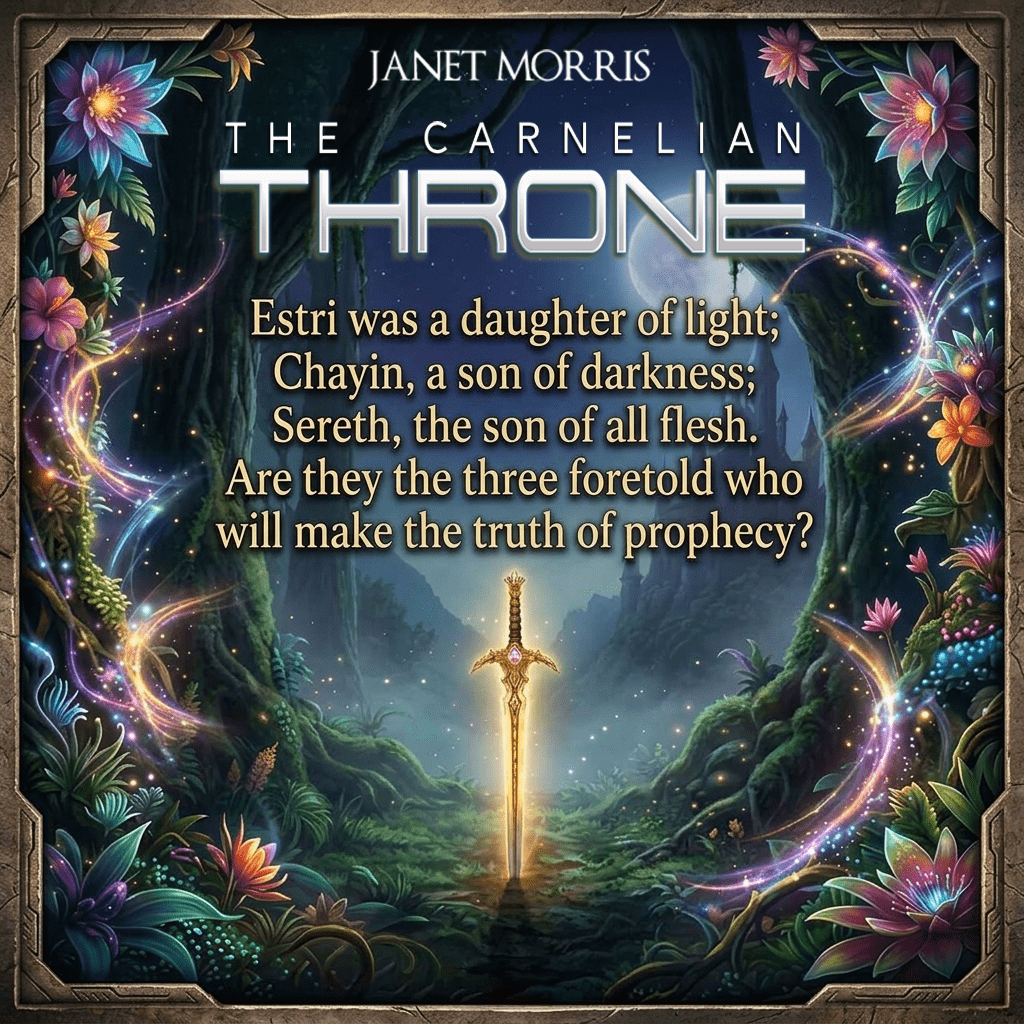
Estri was a daughter of light;
Chayin, a son of darkness;
Sereth, the son of all flesh.
Are they the three foretold who will make the truth of
prophecy?

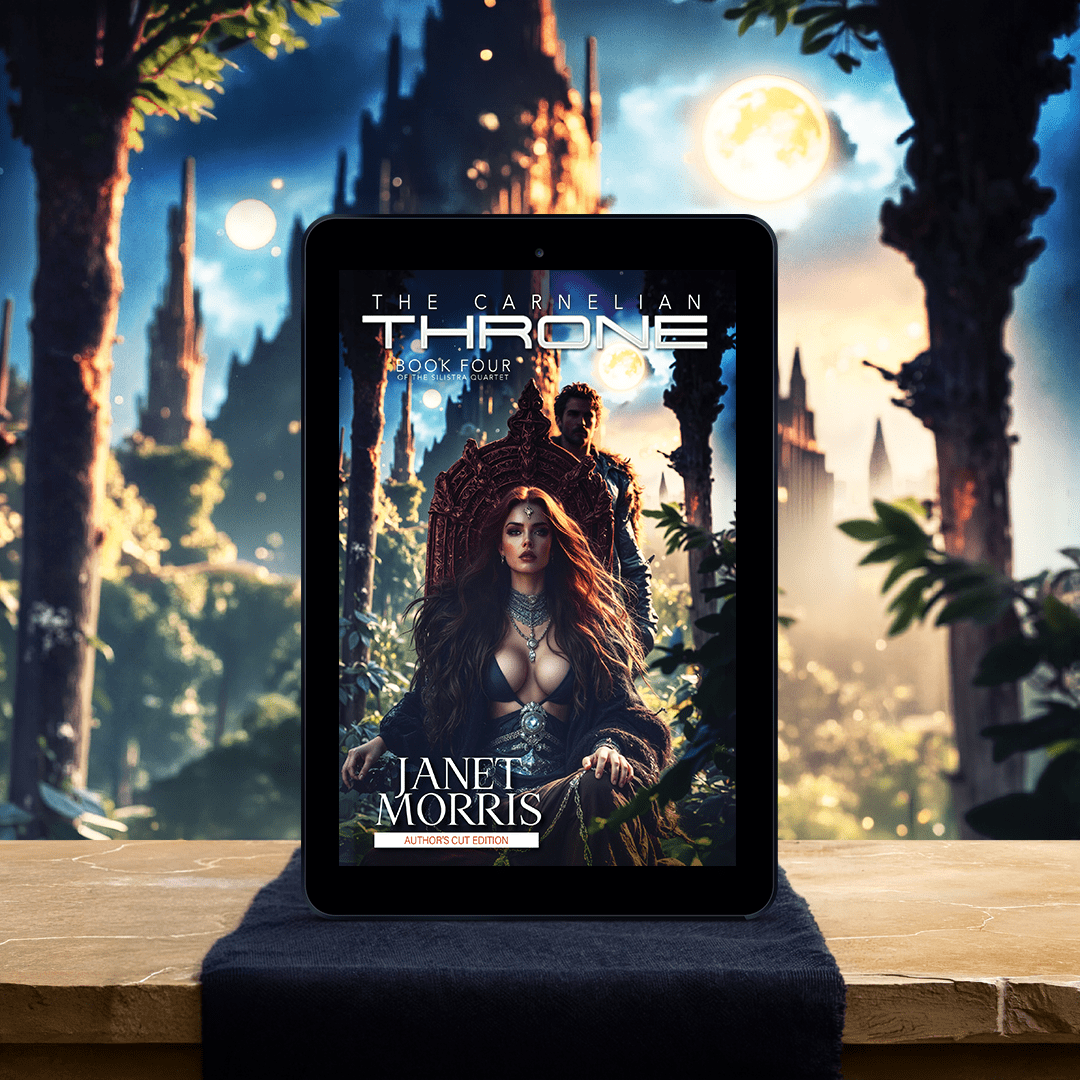
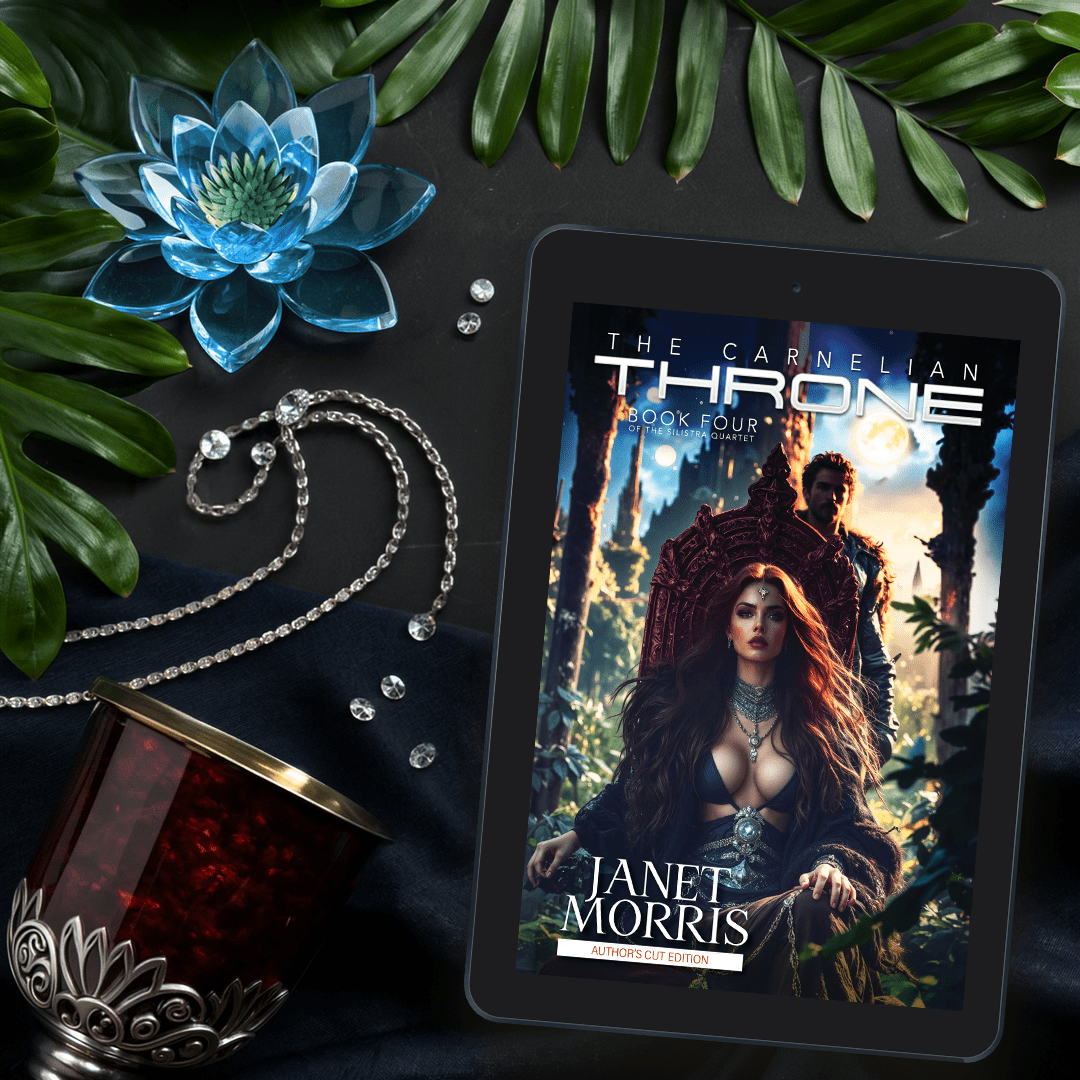
The Carnelian Throne
The Silistra Quartet Book 4
by Janet Morris
Genre: Dystopian Epic SciFi Fantasy Romance

***** "Engrossing characters in a marvelous
adventure." -- C. Brown, Locus Magazine
***** "The amazing and exotic adventures of the most beautiful courtesan
in tomorrow's universe." -- Frederik Pohl
***** "The best single example of prostitution used in fantasy is in Janet
Morris' Silistra series: High Couch of Silistra (originally entitled Returning
Creation), The Golden Sword, Wind from the Abyss, and The Carnelian
Throne." -- Anne K. Kaler, "The Picara: From Hera to Fantasy
Heroine."
"[...] today I thought I'd look at one of the most successful fantasy
debuts of all time, a series that became a huge international hit with its
first release, launching the career of one of the most prolific fantasy writers
of the late 20th Century: Janet Morris' The Silistra Quartet.
"The Silistra Quartet began with Janet's first novel,
High Couch of Silistra [...] from Bantam Books in 1977 [, ] the far-future tale
of the colony planet of Silistra, still recovering from an ancient war that
left the planet scarred and much of the population infertile. With a
dangerously low birth-rate, it's not long before the human colonists of
Silistra develop a new social order, with a hierarchy based on fertility and
sexual prowess.
-- John O'Neill in Black Gate Adventures in Fantasy Literature
Estri was a god, and the daughter of light.
Chayin was a god, and the son of darkness.
Sereth was hase-enor, the son of all flesh.
Lovers and friends, could they be the prophesied three
who would wield the Sword of Severance, Se’Keroth,
and bring light out of dark?
“One from the east, born of ease and destined,
“One from north of south, divine, exempt of question;
the third from out the west,
Astride a tide of death,” quoted Chayin. He was not
smiling. It is a long epic. All has been foreseen. We
all know that tale’s end.”
— Estri Hadrath diet Estrazi, in “Wind from the Abyss.”

“Gate!”
he bellowed over the storm, his dripping lips at my ear. The deluge had made us
sparing of words. Under leathers soaked to thrice their weight, I shivered in
spasms. Arms clutched to my sides, I stared into the rain. The driven sheets
slashed me for my audacity. Lightning flared, illuminating the riverbank white.
A moment later, the bright noise cracked through my head. The hillock trembled.
Over
the gate danced the lightning. Its crackling fingers quested down thick-crossed
slabs of iron, seared flesh. Emblazoned as they tumbled were those six-legged
amphibians, their streamered tails lashing, scaled, fangful heads thrown back
in dismay. I saw their afterimage: beryl and cinnabar, aglow upon the storm.
Then their charred remains splashed into oblivion, spun away on the fast
current.
“Down!”
One man shouted, the other shoved me, and as I staggered to kneel in the
sedges, the god that washed this land shook it, grumbling. I crouched on my
hands and knees on the bucking sod, between them. Little protection could they
offer up against shaking earth and searing sky, not even for themselves,
without divorcing themselves from the reality they had come here to explore.
And that they would not do.
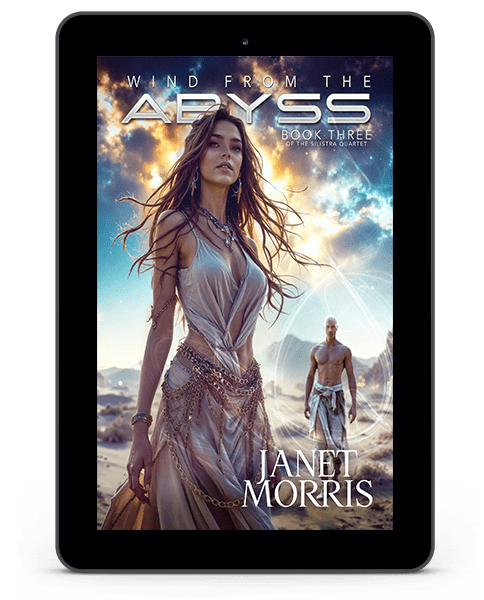
Wind From the Abyss
The Silistra Quartet Book 3
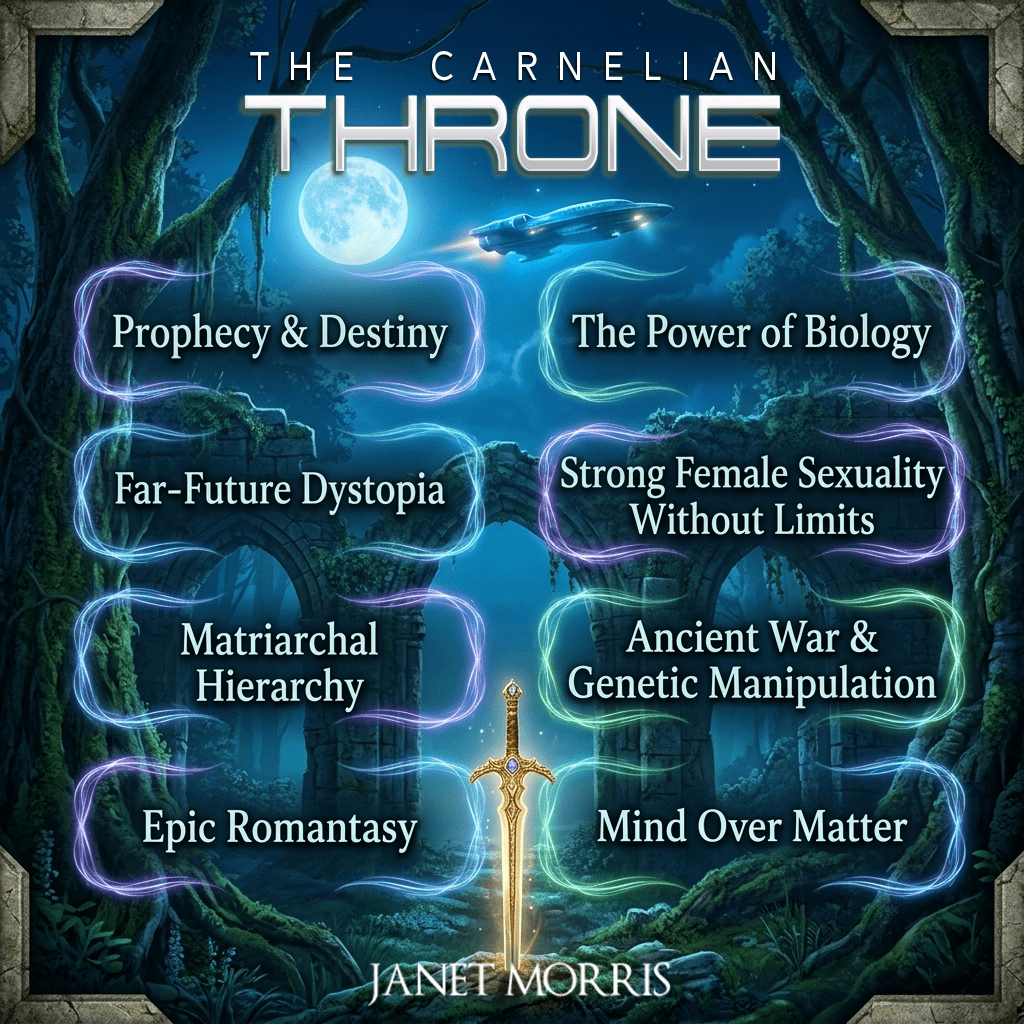
Dystopia. Fantasy. Science fiction. Allegory. Political.
Wind from the Abyss is the third volume in Janet Morris'
classic Silistra Quartet, continuing one woman's quest for self-realization in
a distant tomorrow.
Aristocrat. Outcast. Picara. Slave. Ruler .... She is
descended from the masters of the universe. To hold her he challenges the gods
themselves.
Praise for Janet Morris' Silistra Quartet:
"The amazing and erotic adventures of the most
beautiful courtesan in tomorrow's universe." -- Fred Pohl
"Engrossing characters in a marvelous adventure."
-- Charles N. Brown, Locus Magazine.
"The best single example of prostitution used in
fantasy is Janet Morris' Silistra series." -- Anne K. Kahler, The
Picara: From Hera to Fantasy Heroine.
This Perseid Press Author's Cut Edition is revised and
expanded by the author and presented in a format designed to enhance your
reading experience with larger, easy-to-read print, more generous margins, and
covers designed for these premium editions.
Wind from the Abyss starts with this . . .
"Since, at the beginning of this tale, I did not
recollect myself nor retain even the slightest glimmer of such understanding as
would have led me to an awareness of the significance of the various
occurrences that transpired at the Lake of Horns, I am adding this preface,
though it was no part of my initial conception, that the meaningfulness of the
events described by "Khys' Estri" (as I have come to think of the
shadow-self I was while the dharen held my skills and memory in abeyance) not
be withheld from you as they were from me. I knew myself not: I was Estri
because the girl Carth supposedly found wandering in the forest stripped of
comprehension and identity chose that name. There, perhaps, lies the greatest
irony of all, that I named myself anew after Estri Hadrath diet Estrazi, who in
reality I had once been. And perhaps it is not irony at all, but an expression
of Khys' humor, an implicit dissertation by him who structured my experiences,
my very thoughts, for nearly two years, until his audacity drove him to bring
together once more Sereth crill Tyris, past-Slayer, then the outlawed Ebvrasea,
then arrar to the dharen himself; Chayin rendi Inekte, cahndor of Nemar,
co-cahndor of the Taken Lands, chosen son of Tar-Kesa, and at that time Khys'
puppet-vassal; and myself, former Well-Keepress, tiask of Nemar, and lastly
becoming the chaldless outlaw who had come to judgment and endured ongoing
retribution at the dharen's hands. To test his hesting, his power over owkahen,
the time-coming-to-be, did Khys put us together, all three, in his Day-Keeper's
city -- and from that moment onward, the Weathers of Life became fixed:
siphoned into a singular future; sealed tight as a dead god in his mausoleum,
whose every move brought him closer to the sum total, obliteration. So did the
dharen Khys bespeak it, himself. . ."
“Morris, so good
at giving us characters we can identify with, characters we can love and hate,
strikes at the very heart of the human condition and the duality of humanity —
both good and evil. Her prose is lean and spot-on, every word carefully chosen to
enhance the milieu of her imaginary world and advance the plot, giving us
access to the thoughts, emotions and machinations of the people whose stories
she is presenting to us. Once again, she gives us a “thinking man’s” science
fiction/fantasy that explores the nature of power and sexuality, and how they
can be used, misused and abused. This is a brilliant, mature and very adult
novel that will not only leave you thinking about your own place in the
universe, but questioning the very nature of existence.” – Goodreads reviewer


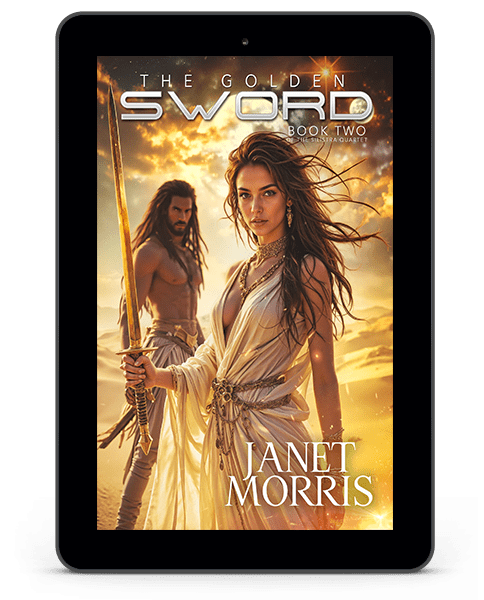
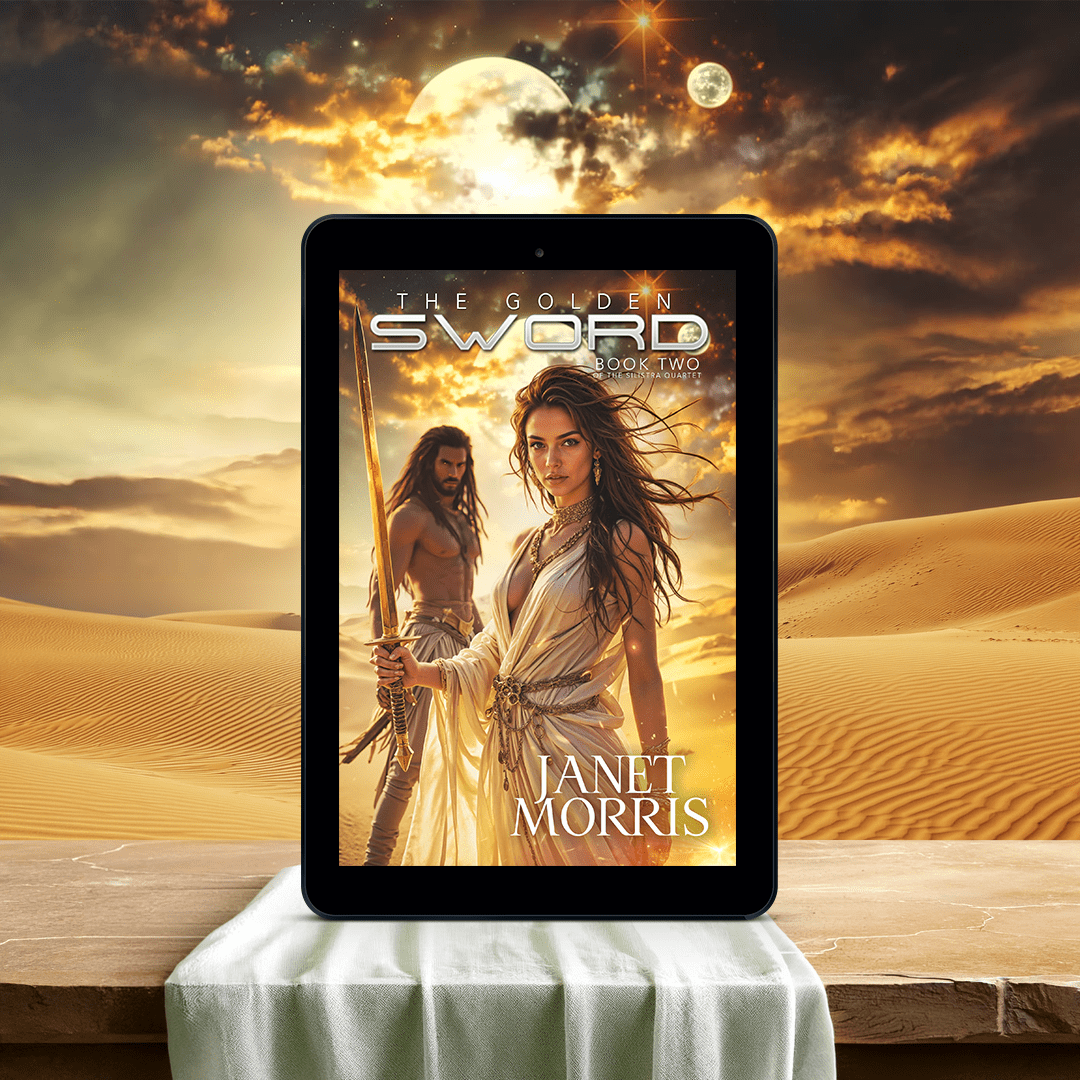
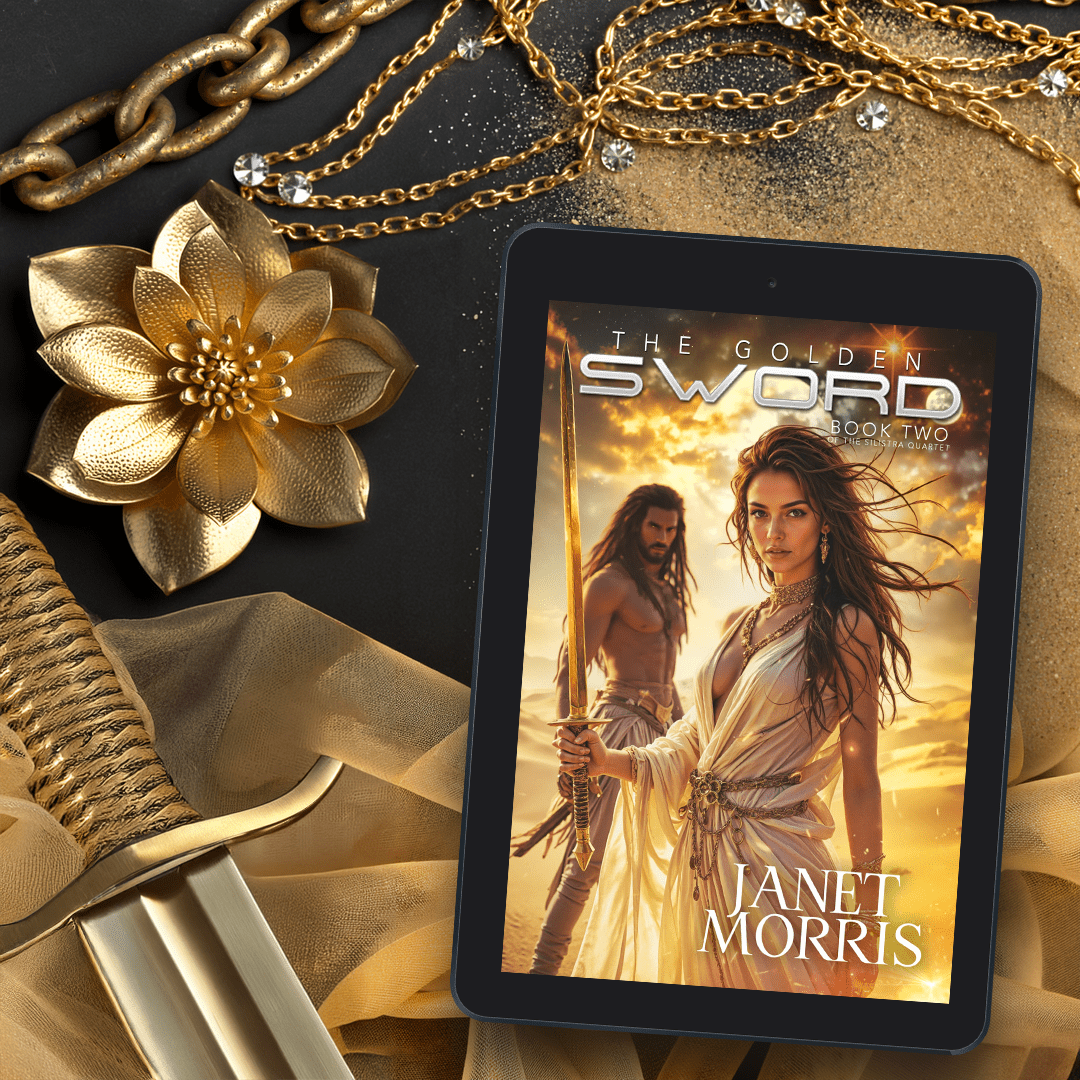
The Golden Sword
The Silistra Quartet Book 2
Dystopia. Biology shapes reality. The further adventures of
the most beautiful courtesan in the galaxies of tomorrow.
She had the power to create planets. The sixty carved bones
of the Yris-tera foretold her ancient fate. Her heritage of power took her
beyond time and space and stole from her the one man she loved.
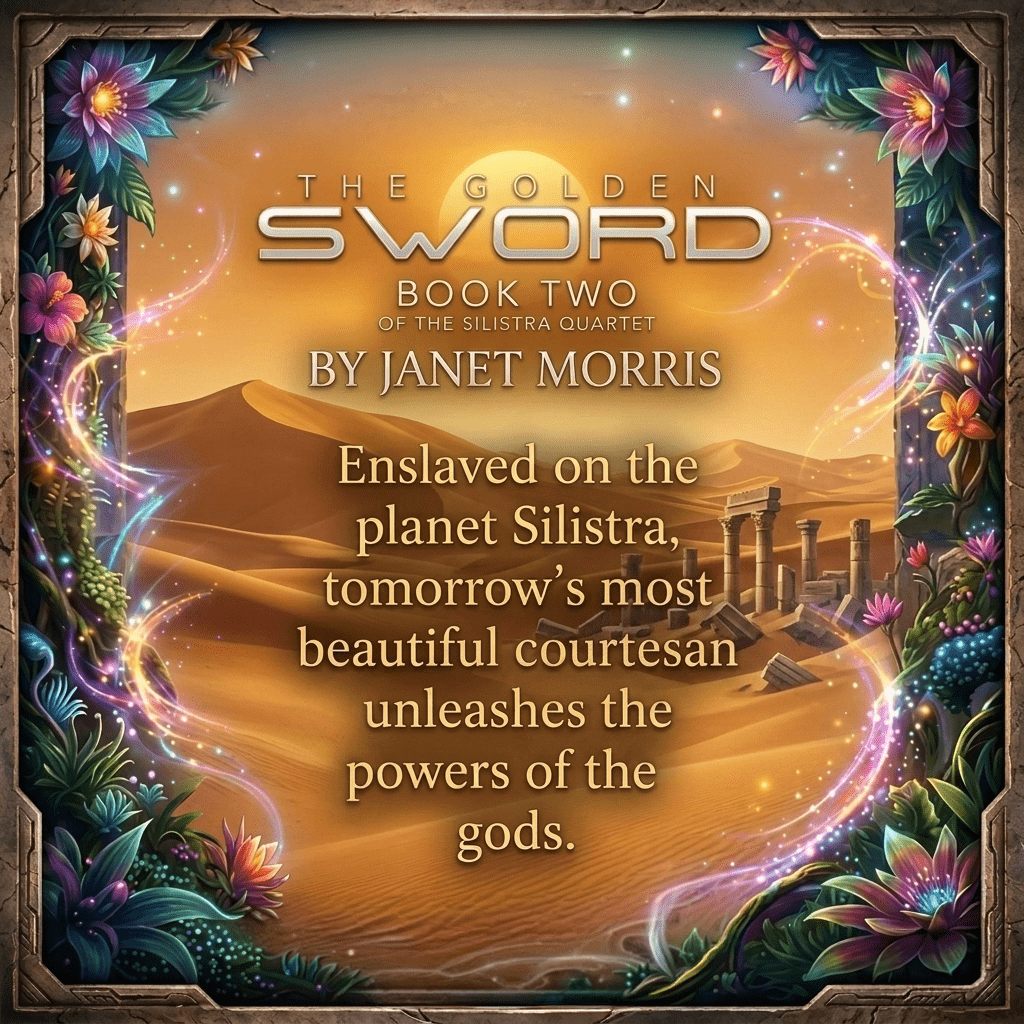
Enslaved on the planet Silistra, tomorrow's most beautiful
courtesan unleashes the powers of the gods.
What readers
are saying:
“Pure excellence…. A heroic quest of the highest
calibre.” - Goodreads
“This is a book which makes one’s blood sing and one’s
mind ponder. I loved the first in the series and enjoyed this as much, perhaps
more. The ending leaves the reader desperate to know what happens to Estri next
– courtesan, slave, warrior, lover, rebel. What is next for our heroine?” –
Goodreads
“Call it what you like: science fiction, space opera,
sword and planet or erotic fantasy . . . The Golden Sword is all these things,
and so much more. A highly intelligent and sensual novel filled with ideas and
revelations, this is a gripping story that explores human sexuality and the
role it plays in politics. Although the memorable characters are bisexual, toss
away all your preconceived notions, for there is a humanity, a strength of will
and determination, a realism and depth of emotion to these characters that will
have you thinking twice about all you know and all you think you know. This is
a book for mature and discerning readers who like some meat on the bones of the
books they read. Janet Morris led the way for all the science fiction authors, both
male and female, who came after. “ – Joe Bonadonna, Goodreads
Amazon * B&N * Bookbub * Goodreads
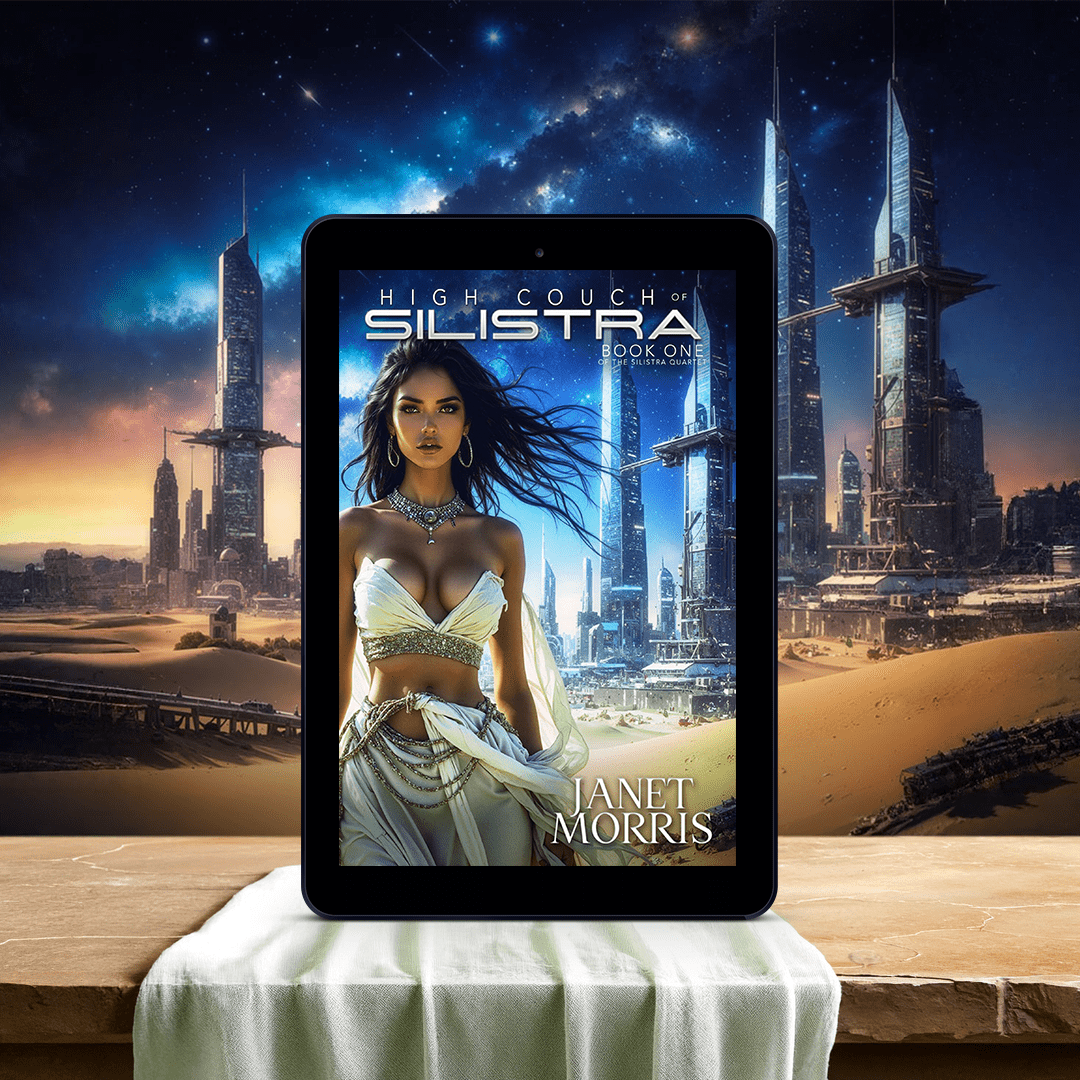
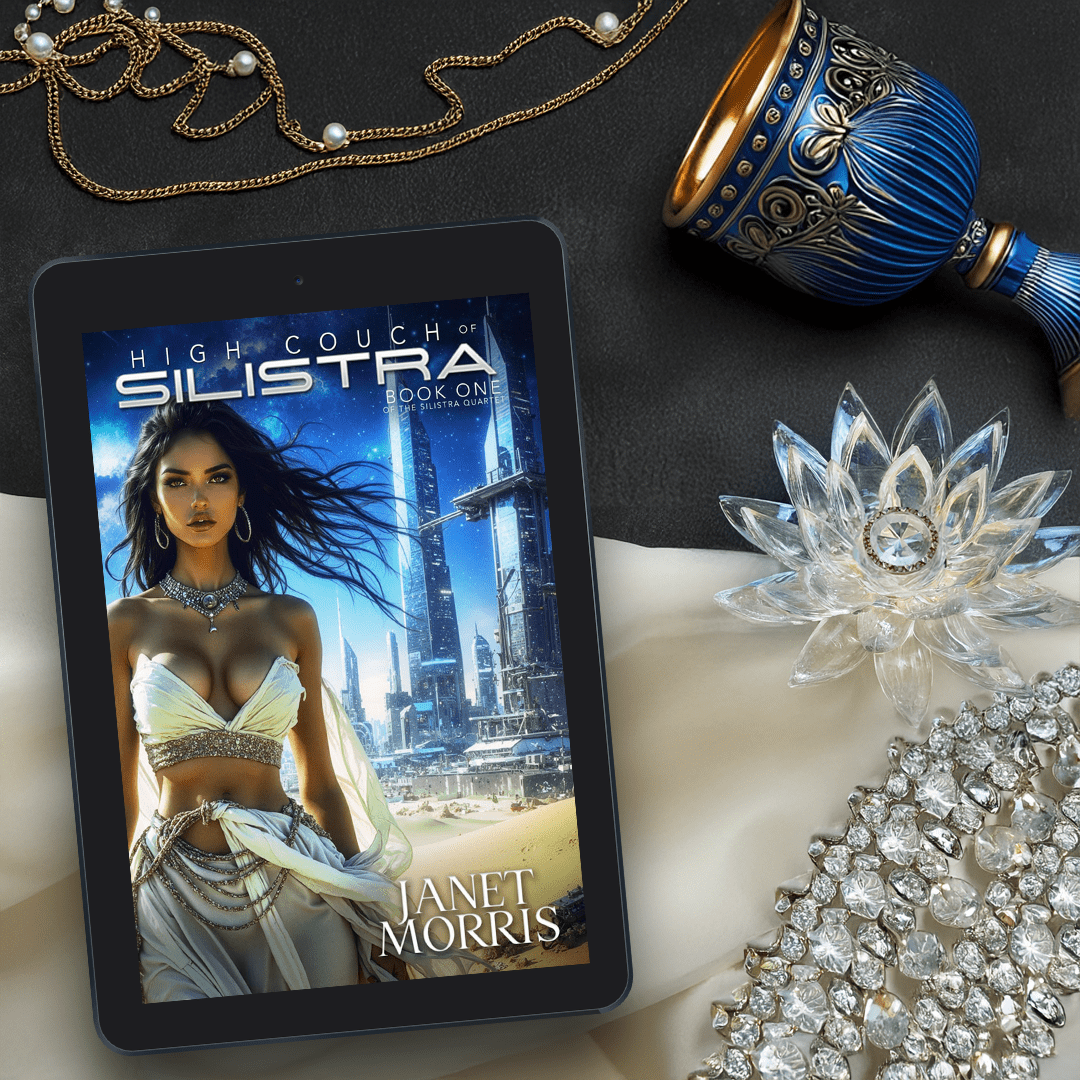
High Couch of
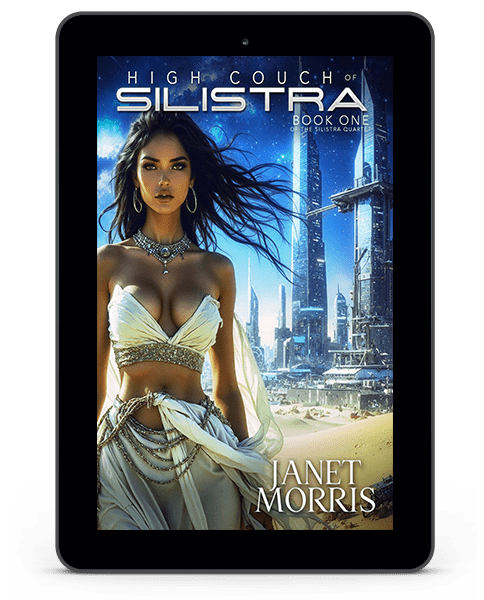
Silistra
The Silistra Quartet Book 1
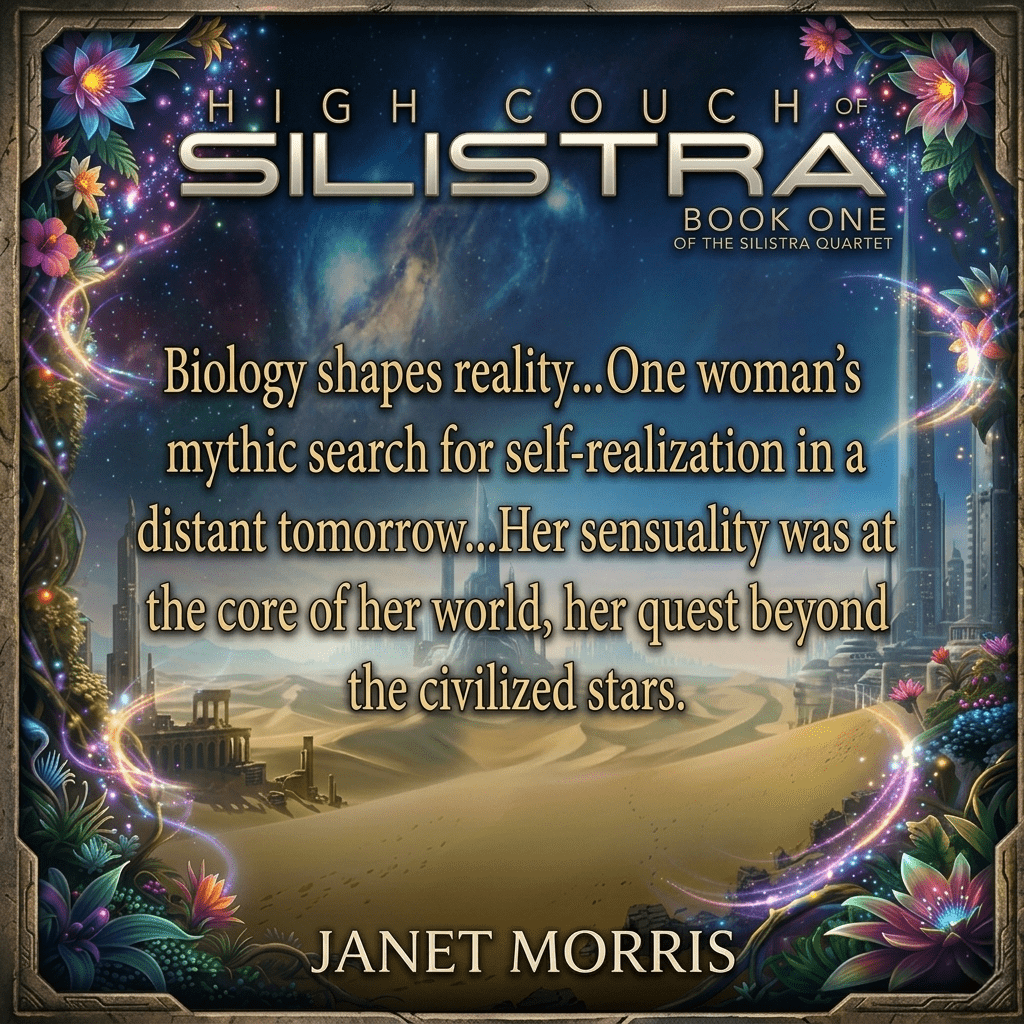
Biology shapes reality...
One woman's mythic search for self-realization in a distant tomorrow...
Her sensuality was at the core of her world, her quest beyond the civilized
stars.
Aristocrat. Outcast. Picara. Slave. Ruler.
"Engrossing characters in a marvelous adventure." - Charles N. Brown,
Locus Magazine
"The amazing and erotic adventures of the most beautiful courtesan in
tomorrow's universe" - Frederik Pohl
"The best single example of prostitution used in fantasy is Janet Morris'
Silistra series... Estri's character is most like that of Ishtar who describes
herself as "'a prostitute compassionate am I'" because she
"symbolizes the creative submission to the demands of instinct, to the
chaos of nature ...the free woman, as opposed to the domesticated woman".
Linking Estri with these lunar and water symbols is not difficult because of
the moon's eternal virginity (the strength of integrity) links with her changeability
(the prostitute's switching of lovers). [...]
Morris strengthens the moon imagery by having Estri as a
well-keepress because wells, fountains, and the moon as the orb which controls
water have long been associated with fertility, [...] In a sense, she is like
the moon because she is apparently eternal, never waxing or waning except in
her pursuit of the quest; she is the prototypical wanderer like the moon and
Ishtar. She is the eternal night symbol of the moon in opposition to the
Day-Keepers [...]
At her majority (her
three hundredth birthday), she is given a silver-cubed hologram letter from her
mother, containing a videotape of her conception by the savage bronzed
barbarian god from another world. [...] If Estri's mother then acts as a bawd,
willing her lineage as Well-Keepress to her daughter, then Estri's
great-grandmother Astria as foundress of the Well becomes a further mother-bawd
figure when she offers her prophetic advice in her letter: "Guard Astria
for you may lose it, and more. Beware of one who is not as he seems. Stray not
in the port city of Baniev ...look well about you, for your father's daughter's
brother seeks you". Having no brother that she knows of does not stay
Estri from undertaking the heroic quest of finding her father."
- Anne K. Kaler, The
Picara: From Hera to Fantasy Heroine
Amazon * B&N * Bookbub * Goodreads


Best selling author Janet Morris began writing in 1976 and
published more than 30 novels, many co-authored with her husband Chris Morris
or others. She contributed short fiction to the shared universe fantasy series
Thieves World, in which she created the Sacred Band of Stepsons, a mythical
unit of ancient fighters modeled on the Sacred Band of Thebes. She created,
orchestrated, and edited the Bangsian fantasy series Heroes in Hell, writing
stories for the series as well as co-writing the related novel, The Little
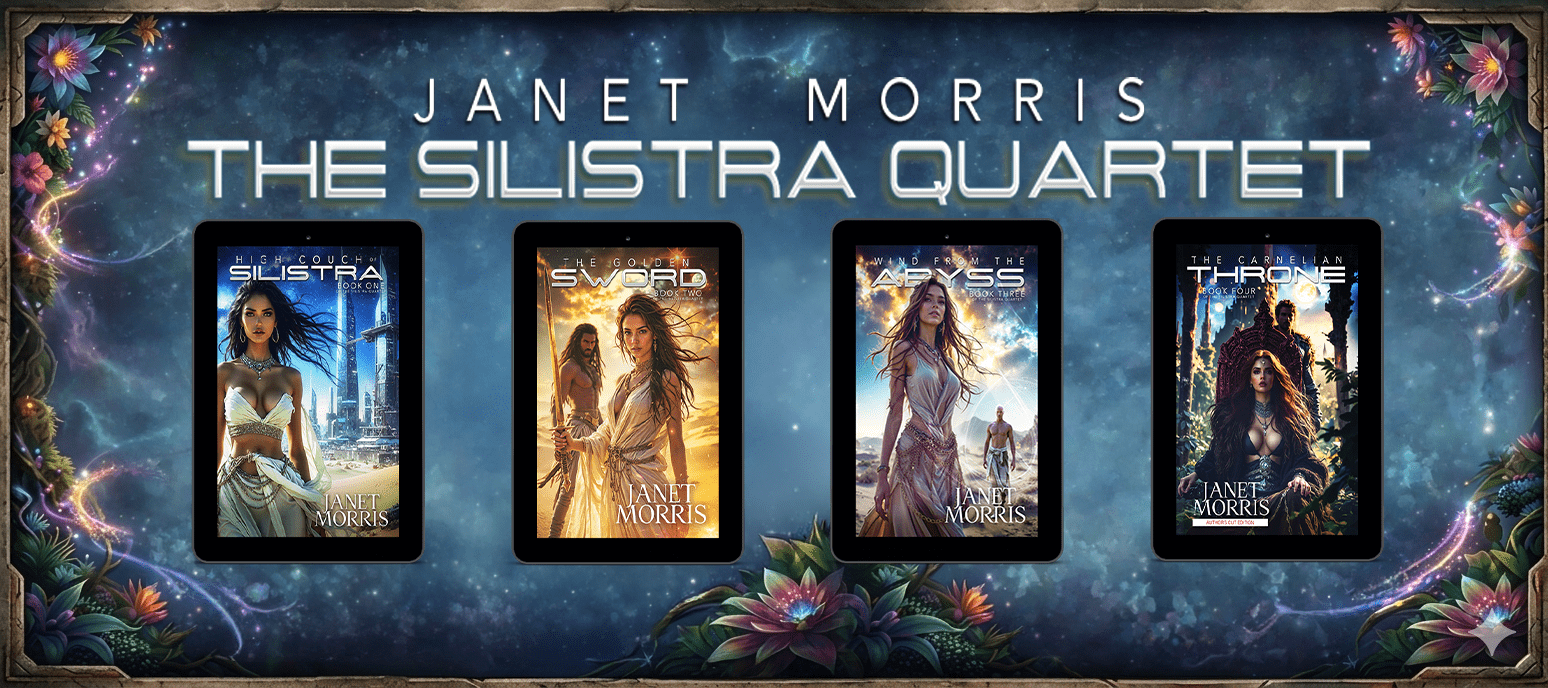
Helliad, with Chris Morris. She wrote the bestselling Silistra Quartet in the
1970s, including High Couch of Silistra, The Golden Sword, Wind from the Abyss,
and The Carnelian Throne. This quartet had more than four million copies in
Bantam print alone, and was translated into German, French, Italian, Russian
and other languages. In the 1980s, Baen Books released a second edition of this
landmark series. The third edition is the Author's Cut edition, newly revised
by the author for Perseid Press. Most of her fiction work has been in the
fantasy and science fiction genres, although she has also written historical
and other novels. Morris has written, contributed to, or edited several
book-length works of non-fiction, as well as papers and articles on nonlethal
weapons, developmental military technology and other defense and national
security topics.
Janet said: 'People often ask what book to read first. I
recommend "I, the Sun" if you like ancient history; "The Sacred
Band," a novel, if you like heroic fantasy; "Lawyers in Hell" if
you like historical fantasy set in hell; "Outpassage" if you like
hard science fiction; "High Couch of Silistra" if you like far-future
dystopian or philosophical novels. I am most enthusiastic about the definitive
Perseid Press Author's Cut editions, which I revised and expanded.'
Website * Facebook * Twitter * Instagram * Bookbub * Amazon * Goodreads

Follow the tour HERE for special content and a giveaway!
Enter the Wind From the Abyss Giveaway Here!


No comments:
Post a Comment